Petermann technology lexicon

Reverse piezo effect (used with oscillating quartz crystals)

Areyou familiar with the piezo lighter? You press the trigger so that a spark is produced by a piezo element, which then ignites the escaping gas.

With oscillating quartz crystals, the reverse piezo effect is used. This means that the resonator is made to vibrate by applying an external voltage.

The reverse piezo effect describes the property of certain crystalline materials - especially quartz (SiO₂) - to deform mechanically when an electrical voltage is applied. This is proportional to the applied electric field strength and depends on the crystal orientation.

How oscillating quartz crystals work

This effect is utilised in a vibrating quartz crystal:

If an alternating voltage is applied to the electrodes of a quartz crystal, it begins to vibrate mechanically due to the reverse piezo effect. The frequency of this oscillation depends on the geometric properties (e.g. thickness and cutting angle) of the quartz crystal and is typically in the kHz to MHz range.

Significance

This mechanical oscillation is extremely stable and precise. This makes quartz crystals ideal as clock generators in electronic circuits - for example in clocks, microcontrollers, communication devices and frequency generators.

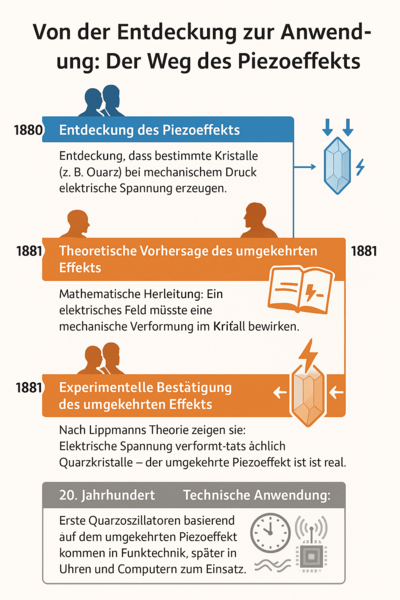
From discovery to application: The path of the piezo effect

Discovery of the piezoelectric effect

- Discoverer: Jacques and Pierre Curie

- Year: 1880

- Description: The Curie brothers discovered that certain crystals (e.g. quartz, tourmaline, topaz) generate electrical charges on their surfaces during mechanical deformation - this effect became known as the direct piezoelectric effect.


Prediction of the reverse piezoelectric effect

- Theorist: Gabriel Lippmann

- Year: 1881

- Description: Lippmann theorised that due to the reversibility of physical processes, the reverse effect must also exist: An electrical voltage should cause a mechanical deformation in the crystal.


Experimental confirmation of the reverse effect

- Researchers: Jacques and Pierre Curie

- Year: 1881

- Description: Shortly after Lippmann's prediction, the Curie brothers experimentally confirmed that crystals do indeed deform mechanically under electrical voltage - the reverse piezoelectric effect was thus proven.


It is very exciting to learn that oscillating quartz uses a basic technology that was discovered by the Curie brothers over 145 years ago.

If you have any further questions, please contact us at info@petermann-technik.de or call us on +49/8191/305395. Our experts look forward to hearing from you.


Telephone contact

Our frequency experts are there for you

Call now

Write to us

Send us an e-mail - we will be happy to help you

Write an e-mail now