

This explanation describes the crystallographic axes of a synthetic quartz crystal and the different types of cut (AT, BT and SC cut) used in the production of quartz crystals.
1. crystal structure of quartz
Quartz (SiO₂) crystallises in the trigonal crystal system. The structure consists of a network of SiO₄ tetrahedra arranged in a spiral along the Z-axis (also known as the c-axis).
2. crystallographic axes
A synthetic quartz crystal has the following main axes:
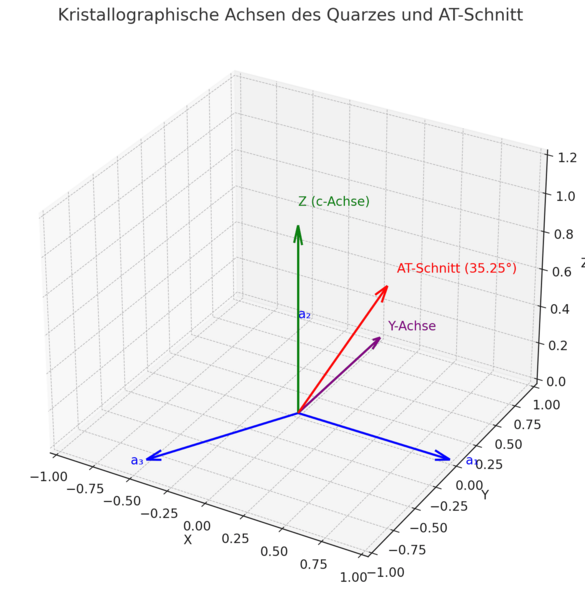
- a₁-, a₃-, a₃-axes (x-axes): In one plane, 120° to each other.
- Z-axis (c-axis): Corresponds to the optical axis.
- Y-axis: Electrical axis, perpendicular to the Z-axis.
3. AT section
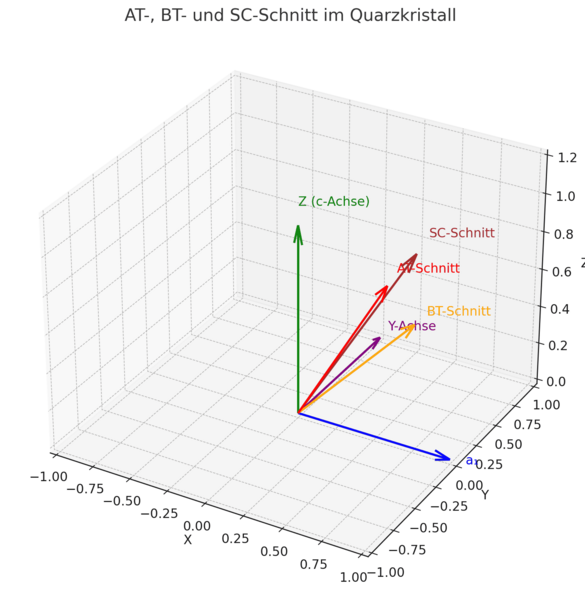
The AT section is an inclined section (approx. 35.25°) against the Z axis in the X-Z plane. It is used to produce temperature-stable oscillating crystals. The oscillation takes place in the plate plane (planar mode).
4. other quartz cut types
A comparison of the most important cut types:
Feature | AT cut | BT cut | SC cut |
Cutting angle | ~35.25° against Z | ~49° against Z | ~34° against Z, 22.5° against Y |
Temperature behaviour | Very good | Medium | Excellent |
Frequency stability | Good | Medium | Very high |
Mechanical stability | High | Slightly lower | Very high |
Application | Standard oscillating crystals | Watches, favourable | Space travel, precision devices |
6. use - which quartz cut is used where?
AT-Cut
The AT-Cut is the most widely used crystal cut for quartz crystals and is used to manufacture all our LRT (LOW ESR Resonator Technology) quartz crystals. AT-Cut crystals are characterised by good temperature stability, low frequency drift and a wide range of applications. AT-cut crystals can be miniaturised very well and are ideal for resonant crystals in the 3.2 - 285 MHz range.
The frequency tolerance at +25°C for our AT-Cut quartz crystals is ±10 ppm at +25°C. Ageing is in the range of ±10 ppm after 10 years. Over the temperature range of -20/+70°C, the narrowest possible temperature stability is ±10 ppm, over -40/+85°C ±15 ppm, over -40/+105°C = ±30 ppm, and ±50 ppm over the temperature range of -40/+125°C.
The AT oscillating quartz crystal therefore fulfils all requirements, even for very precise radio applications (ISM band, WiFi, etc.).
BT-Cut
The BT-Cut is an old cutting angle and was used in the past when the AT cutting angle was not yet so highly developed. BT-Cut oscillating crystals had greater temperature stability than AT-Cut crystals, but could be manufactured more cheaply in a wide range of frequencies than AT-Cut crystals. BT-Cut quartz crystals are no longer manufactured today - they have been completely replaced by AT-Cut quartz crystals.
SC-Cut
The SC-Cut cutting angle (Stress Compensated Cut) is a double-rotated quartz cut that offers excellent temperature stability, very low ageing and extremely high long-term stability. It is used in particular in precision oscillators such as OCXOs, where the smallest frequency deviations are critical (e.g. in telecommunications, 5G, GPS references, measurement technology, etc.).
OCXOs are Oven Controlled Crystal Oscillators, where an internal "oven" is used to keep the SC-cut crystal at a constant ideal temperature. This ideal temperature is in the range of 80 - 85°C where the SC-cut crystal also has its 0-cycle. Another special feature of the SC-Cut quartz crystals in OCXOs are the oscillation modes. For example, in OCXOs, SC quartz frequencies with 5 or 10 MHz are not realised in the fundamental, but in the 5th harmonic. Why? It's about the C1 or dynamic capacitance. A crystal in the 5th overtone has a much smaller C1 than a fundamental crystal, so that the SC cut crystal in the OCXO oscillates much more accurately.
FAQs
What are crystallographic axes in quartz and why are they important for quartz crystals?
Quartz crystallizes in the trigonal crystal system and has defined crystallographic axes, which are decisive for its electrical and mechanical properties. The main axes include the a₁, a₂ and a₃ axes in a plane each 120° apart, the Z-axis as the optical axis and the Y-axis as the electrical axis perpendicular to the Z-axis. These axes serve as a reference system for the alignment of the quartz cut during the production of quartz crystals. Even small changes in the cutting angle influence the temperature behavior, type of oscillation and long-term stability of the resonator. The crystallographic axes are therefore the basis for the selection of suitable quartz cut types such as AT, BT or SC cut.
What is the difference between AT-, BT- and SC-cut for quartz resonators?
The AT cut is an inclined cut against the Z-axis in the X-Z plane and is mainly used for temperature-stable standard oscillating crystals. It is the most widely used crystal cut today and offers a good combination of temperature stability, low frequency drift and a wide range of applications. The BT cut is an older cut angle that was used in the past but has now been almost completely replaced by the AT cut. The SC cut is a double-rotated, stress-compensated quartz cut with particularly high temperature stability, low ageing and excellent long-term stability. This makes the SC cut particularly suitable for high-precision applications such as OCXOs, telecommunications, 5G, GPS references and measurement technology.
Why is the AT-Cut the standard for modern quartz crystals?
The AT-Cut has established itself as the standard because it combines very good temperature stability with high production maturity and broad applicability. It is used at PETERMANN-TECHNIK for all LRT oscillating crystals and is ideal for frequency ranges from 3.2 to 285 MHz. AT-cut crystals can be miniaturized very well and are therefore also interesting for compact electronic assemblies. The frequency tolerance at +25°C is ±10 ppm, and ageing is also very low at ±10 ppm after 10 years. In addition, the AT oscillating crystal fulfills even demanding requirements in precise radio applications such as ISM band or WiFi.
What temperature stability do AT-Cut oscillating crystals achieve in different temperature ranges?
AT-Cut oscillating crystals offer different stability values depending on the specified temperature range and are therefore suitable for many industrial applications. Over the range from -20 to +70°C, the narrowest possible temperature stability of ±10 ppm can be achieved. For the extended range from -40 to +85°C, the stability is ±15 ppm. With even higher requirements for the application range, ±30 ppm over -40 to +105°C and ±50 ppm over -40 to +125°C are possible. These values show that the AT section is a very well-balanced solution for applications with high demands on frequency accuracy and temperature behavior.
Why is the SC-Cut used in OCXOs and precision oscillators?
The SC cut is used in precision oscillators because it offers excellent temperature stability, very low ageing and extremely high long-term stability. In OCXOs, the quartz is kept at a constant ideal temperature of around 80 to 85°C by an internal oven, where the SC cut has its 0 cycle. This allows the smallest frequency deviations to be minimized particularly effectively. In addition, SC cut crystals in OCXOs at 5 or 10 MHz are often not operated in the fundamental, but in the 5th overtone. The smaller dynamic C1 in overtone mode helps the crystal to oscillate even more precisely.
Why PETERMANN-TECHNIK quartz cut types and crystallographic axes?
PETERMANN-TECHNIK is the right choice when it comes to in-depth expertise on quartz cutting modes and their influence on the performance of quartz crystals. The company combines technical understanding of crystallographic axes, cutting angles and vibration modes with practical advice for industrial applications. PETERMANN-TECHNIK has clear specifications on frequency range, temperature stability, tolerance and ageing, particularly for the widely used AT-Cut. Application-oriented expert knowledge is also available for demanding topics such as SC-Cut crystals for OCXOs and precision applications. Customers therefore benefit from technical security, industry-specific advice and solutions that are precisely tailored to the frequency stability and operating environment.


