

1. history of synthetic quartz production
Early use of natural quartz
- Until the middle of the 20th century, natural quartz was predominantly used - e.g. from deposits in Brazil, Madagascar or the USA.
- The demand for high-purity, low-defect and specifically orientated quartz for oscillating quartz crystals increased massively, particularly during the Second World War (radar, radio technology).
- However, natural quartz often showed inclusions, lattice defects or twinning, which led to unstable frequencies.
Development of synthetic quartz crystals
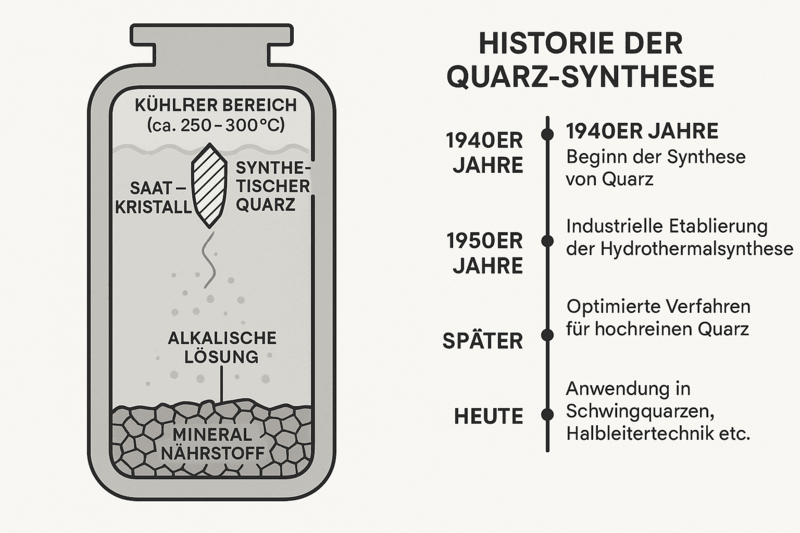
- In the 1940s, the synthesis of quartz began in so-called hydrothermal plants - a process that imitates natural growth conditions.
- From the 1950s onwards, hydrothermal synthesis was established on an industrial scale.
- Later, the process was optimised to produce high-purity and defect-free quartz blocks, primarily for semiconductor and frequency technology.
2. production of synthetic quartz blocks
Basic raw material
- The base material is high-purity silicon dioxide (SiO₂) - e.g. in the form of natural quartz, amorphous silica or purified silica from chemical processes.
- Extremely low impurities are crucial for electronic applications (ppb range, especially for Al, Na, Fe).
The hydrothermal process
The principle
- Simulation of geological conditions: high pressure, high temperature, water-based solution.
- Similar to the autoclave process used for synthetic gemstones.
Process steps
- Autoclave preparation:
- A pressure-resistant reactor (autoclave) is filled with a mineral nutrient (e.g. pulverised natural quartz) and an alkaline solution (usually NaOH or Na₂CO₃).
- Temperature gradient:
- In the lower part: higher temperature (approx. 350-400 °C) → where the SiO₂ dissolves.
- In the upper part: cooler (approx. 250-300 °C) → SiO₂ crystallises there.
- Germination insert:
- Seed crystals of quartz with a defined orientation are inserted at the top of the autoclave, on which the dissolved silicon dioxide grows.
- Crystal growth:
- Duration: several weeks to months.
- Result: synthetic single-crystal quartz with high structural perfection.
3. properties & quality
Advantages of synthetic quartz:
- High purity (few ppm/ppb impurities).
- Controlled crystal orientation (e.g. AT or BT cut for oscillating quartz).
- No twins or inclusions as with natural quartz.
- Reproducibility of physical properties.
Cleaning
- In some cases, the starting material is purified again by chemical cleaning or zone-melting processes before growth.
Utilisation
- Quartz oscillators / quartz crystals: Frequency-stable oscillators for all applications in electronics
- Semiconductor industry: Quartz glass made from synthetic quartz (e.g. for reactor tubes).
Optics: Lenses, prisms made of crystalline quartz.
We check every quartz ingot 100% during the incoming goods process. The purity and the corresponding crystallographic axes are checked optically (X-ray process). The quartz ingot is then given a prefixed number so that it can be integrated into the traceability of the quartz resonator batches. This means that our production batch availability can be traced back to the incoming inspection of the quartz raw block. All in line with our sophisticated manufacturing process for clock generators of the highest quality, performance and service life.
FAQs
What is synthetic quartz and why is it so important for quartz crystals?
Synthetic quartz is artificially grown single-crystal quartz that is specially produced for technical applications with high quality requirements. This material is particularly important for vibrating quartz crystals because it offers high purity, a defined crystal orientation and very good structural perfection. Compared to natural quartz, there are significantly fewer inclusions, lattice defects or twinning, which can impair frequency stability. In frequency technology in particular, reproducible physical properties are crucial in order to achieve constant electrical and mechanical vibration characteristics. This is why synthetic quartz forms the central basis for high-quality quartz resonators and frequency-stable oscillators in modern electronics.
How does the hydrothermal process for producing synthetic quartz blocks work?
The hydrothermal process imitates the natural geological growth conditions of quartz under controlled industrial conditions. High-purity silicon dioxide as a nutrient and an alkaline solution, usually based on NaOH or Na2CO3, are introduced into a pressure-resistant autoclave. Higher temperatures of around 350 to 400 degrees Celsius prevail in the lower area of the reactor, so that the SiO2 dissolves there. In the upper, cooler area at around 250 to 300 degrees Celsius, the dissolved material crystallizes out again on seed crystals with a defined orientation. Over several weeks to months, synthetic single-crystal quartz blocks with high purity and very good suitability for vibrating quartz crystals are produced.
What are the advantages of synthetic quartz over natural quartz for frequency technology?
Synthetic quartz offers decisive advantages for frequency technology because its material properties can be specifically controlled. Natural quartz often has inclusions, lattice defects or twinning, which can lead to unstable frequencies and fluctuating component properties. Synthetically produced quartz, on the other hand, achieves a very high purity down to the ppm or ppb range and enables a defined crystal orientation, for example for AT or BT sections. This allows quartz crystals with reproducible electrical and mechanical properties to be produced. For industrial applications, this means greater frequency stability, higher process reliability and better long-term performance.
What are the purity requirements for synthetic quartz in electronic applications?
For electronic applications, synthetic quartz must have extremely low levels of impurities, as even the smallest foreign substances can affect the oscillation properties. Trace elements such as aluminum, sodium or iron, which must be controlled in the ppb range, are particularly critical. High-purity silicon dioxide, which can come from natural quartz, amorphous silica or chemically purified processes, is therefore used as the starting material. In some cases, the material is additionally chemically purified before crystal growth or further refined using purification processes. This high material purity is an essential prerequisite for high-performance quartz crystals, quartz oscillators and other frequency-generating components.
How is the quality of synthetic quartz ingots for quartz crystals tested?
The quality of synthetic quartz ingots is comprehensively tested as early as the incoming goods stage in order to ensure a reliable basis for the subsequent production of quartz crystals. Each quartz ingot is checked 100 percent, particularly with regard to its purity and the correct crystallographic axes. The inspection is carried out optically and also via an X-ray process in order to precisely evaluate the material structure and orientation. Each ingot is then given a consecutive number so that it can be fully integrated into the traceability of the quartz resonator batches. This seamless traceability supports a quality-oriented production process for clock generators with high performance, reliability and service life.
Why PETERMANN-TECHNIK synthetic quartz for quartz crystals?
PETERMANN-TECHNIK is a strong choice for synthetic quartz for vibrating quartz crystals because quality assurance and traceability are consistently integrated into the production process. Each quartz ingot is 100% inspected on receipt of goods, with purity and crystallographic axes checked optically and by X-ray. The continuous marking of each ingot enables seamless traceability up to the incoming goods inspection, which is an important quality factor for industrial B2B customers. This systematic control supports the production of clock generators with high quality, stable performance and a long service life. At the same time, experienced frequency experts are available to answer technical questions and provide application-related advice.


