

FAQs
What does the fundamental oscillation mean for MHz oscillating crystals?
The fundamental oscillation is the lowest natural oscillation frequency of a quartz crystal. It is a central operating principle for MHz quartz crystals because it enables a stable and defined frequency to be provided. In this oscillation mode, the crystal operates without using higher harmonics. This is particularly important when a precise frequency reference with good stability behavior is required. The selection of the appropriate fundamental frequency therefore directly influences the electrical and mechanical design of the component.
What types of oscillation are there for quartz crystals?
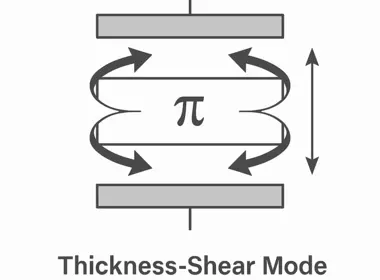
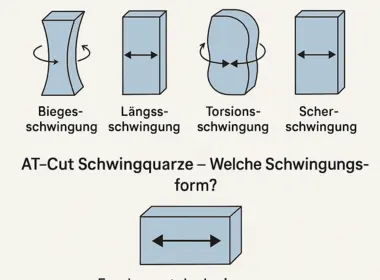
Quartz crystals can be operated in various mechanical vibration modes, which are used specifically depending on the application. These vibration modes determine how the quartz behaves mechanically and which frequency characteristics can be achieved. This is relevant for frequency technology because different modes fulfill different requirements in terms of stability, frequency range and operating conditions. The choice of the appropriate oscillation mode is therefore closely related to the subsequent application. Precise knowledge of the oscillation modes is crucial for the technically correct design of quartz crystals.
Why is synthetic quartz so important for quartz crystals?
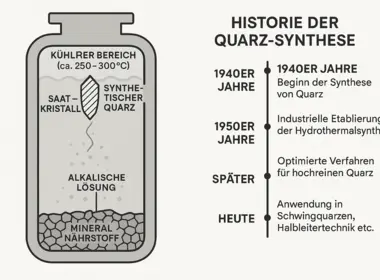
Synthetic quartz is the basis for modern oscillating crystals because it can be produced with high purity and controlled material properties. The production of synthetic quartz blocks is therefore a key process in frequency technology. Compared to natural materials, synthetic quartz offers better reproducibility and consistent quality. This has a direct effect on the electrical performance, long-term stability and reliability of the finished quartz crystal. For industrial applications, synthetic quartz is therefore an essential factor for precise frequency components.
How do mechanical vibration modes influence the properties of quartz crystals?
The mechanical vibration modes of a quartz crystal have a direct influence on its frequency behavior and its possible applications. Depending on the mode, the resonance behavior, stability and suitability for certain frequency ranges change, among other things. This is important in practice because not every oscillation mode is equally suitable for every application. The right balance between material, geometry and oscillation mode plays a particularly important role for MHz oscillating crystals. This is the only way to achieve precise and permanently stable frequency solutions.
For which applications are MHz oscillating crystals with a defined oscillation form suitable?
MHz oscillating crystals with a defined oscillation mode are used wherever precise and stable frequencies are required. The selected oscillation mode influences how reliably the quartz works in electronic circuits. This is particularly relevant in industrial, measurement and communication technology applications. A precisely defined fundamental oscillation or a suitable mechanical mode supports the reliable functioning of the overall system. For this reason, the selection of a suitable oscillating quartz is always closely linked to the technical requirements of the application.
Why PETERMANN-TECHNIK for quartz crystals and vibration modes?
PETERMANN-TECHNIK is an experienced partner for oscillating crystals, vibration modes and frequency-determining components. The company combines technical expertise with practical advice for industrial B2B applications. Precise classification is crucial, especially when it comes to topics such as fundamental vibration, mechanical vibration modes and synthetic quartz. PETERMANN-TECHNIK supports customers in finding the right solution for their frequency requirements. As a result, companies benefit from in-depth expertise, a high level of application proximity and reliable technical support.


