
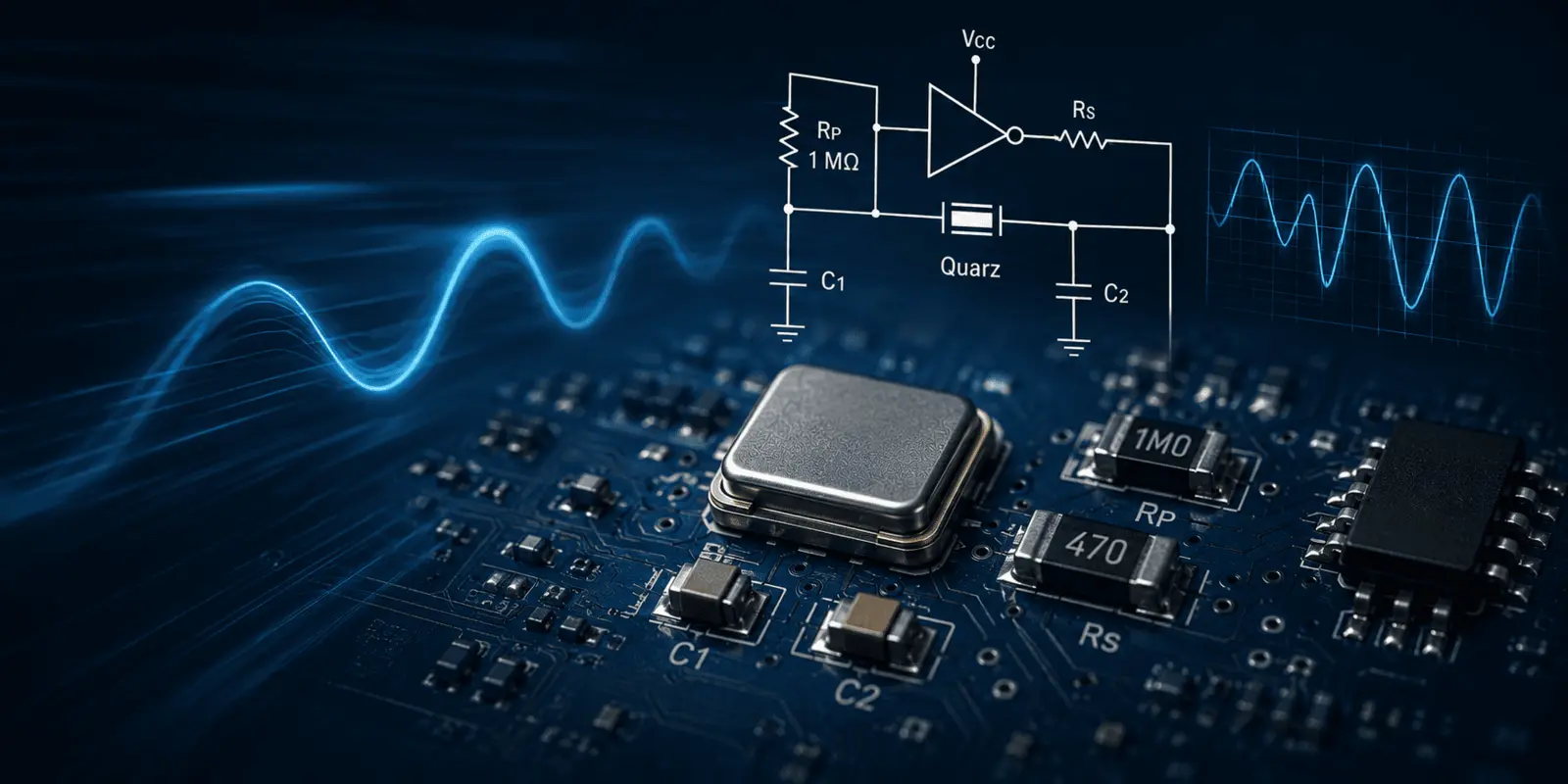
Practical measurement methods for the post "Optimising quartz crystals for ICs" - Section B
To the encyclopaedia article : Matching crystals optimally to ICs
What it's all about
The load capacitance CL defines the operating point of a quartz crystal and thus its actual frequency in the circuit, also known as the operating frequency. Each crystal is trimmed to a specific CL (typically 6 pF, 8 pF, 12 pF, 16 pF, 18 pF or 20 pF for MHz quartz crystals / 4 pF, 6 pF, 7 pF, 9 pF and 12.5pF for 32.768kHz clock crystals). If the CL specification of the crystal and the effective load capacitance of the circuit do not match, a systematic frequency shift occurs - often in the range of a few ppm to several tens of ppm.
This practical post shows how the effective load capacitance can be checked and validated in a real circuit.</p
<h2>Physical background
The effective load capacitance that the crystal "sees" in the circuit results from the series connection of the two external capacitances C1 and C2 plus the parasitic capacitances (stray).
CL_eff = (C1 - C2) / (C1 + C2) + Cstray
Cstray is made up of IC pin capacitance, track capacitance and pad capacitance. Typical guide values in a real layout are 2 pF - in compact, layout-optimised designs sometimes only 1 pF, in unfavourable layouts or with IC pin capacitances up to 7 pF correspondingly higher.
Why a pure calculation is not enough
The calculation from the data sheet provides a good starting value, but is not a guarantee. Deviations arise due to:
- Serial dispersion of the IC pin capacitance (typ. ±30 %)
- Layout variants (trace lengths, number of layers, number of via, proximity to ground planes)
- Fabrication tolerances of the circuit capacitors (C0G/NP0 typ. ±5%, standard ±10%, ±1% for precise applications such as those required in radio applications)
- Temperature and voltage dependence of the pin capacitance
Verification in the real circuit is therefore mandatory if the frequency accuracy is relevant (wireless, USB, Ethernet, timer).
Measurement method A: Frequency method (recommended in series)</h2
<h3>Measurement principle
The actual frequency of the running circuit is measured and compared with the specified nominal frequency. The effective load capacity can be calculated back from the frequency deviation.</p
<h3>Required equipment
Frequency counter with ≥ 0.1 ppm resolution and GPS or OCXO reference (e.g. Keysight 53230A, Pendulum CNT-90)
Probe active, low-capacitive (< 1 pF, e.g. FET probe), e.g. FET probe. e.g. FET probe) so as not to falsify the measurement
Temperature chamber recommended for reference measurement at +25 °C ±1 °C
Execution
Commission the circuit at +25 °C and nominal voltage. Allow to warm up for at least 60 s.
Tap XOUT (oscillator output) with a low-capacitance probe. Do not touch XIN - this is where the probe disturbs the operating point the most.
Average the frequency over ≥ 10 s gate time and note: fmess.
Calculate the deviation: Δf/f = (fmess - fnenn) / fnenn - 10⁶ [ppm]
Calculate the effective CL back from Δf/f (see formula below).
Recalculate CL from Δf/f
Approximation formula (valid in the usual range around CL_spec):
Δf / f ≈ - C1_motional / (2 - (C0 + CL_eff)²) - (CL_eff - CL_spec)
With typical quartz parameters (C1_motional ≈ 3 fF, C0 ≈ 1 pF), the following is a practical rule of thumb:
ΔCL [pF] ≈ Δf/f [ppm] - (CL_spec + C0)² / (C1_motional - 10⁶ / 2)
Simpler and more precise: Read the pull sensitivity from the quartz data sheet (typically -15 to -25 ppm/pF) and use it to convert.
ΔCL = Δf/f / S (S = pull sensitivity in ppm/pF)
Measurement method B: Variation method (to determine Cstray)
This method is the most accurate variant if the parasitic capacitance of the circuit is to be determined:
Set C1 and C2 to a symmetrical test value (e.g. 12 pF each, C0G ±2 %).
Measure the frequency f1.
Switch C1 and C2 to a second value (e.g. 22 pF each). e.g. 22 pF each), measure frequency f2.
Cpar and effective load capacitance can be analytically resolved from two measurement points.
Well suited for initial sample debugging because it also characterises the layout and the determined Cpar values can be reused for similar layouts.
Typical values and acceptance limits
| Criterion | Green area | Assessment / Measure |
|---|---|---|
| |Δf/f| at +25 °C | < 5 ppm | In order |
| |Δf/f| at +25 °C | 5 - 15 ppm | Adjust C1/C2 |
| |Δf/f| at +25 °C | > 15 ppm | check CL variant, determine Cpar |
| Difference XIN / XOUT | < 2 ppm | Symmetrical layout |
| Cpar (from variation method) | 1 - 3 pF | Typical normal range |
| Cpar | > 5 pF | Check layout (short leads, no GND area under quartz) |
Example calculation
Quartz: 26,000 MHz, CL_spec = 8 pF, pull sensitivity S = -18 ppm/pF.
Measurement in the circuit: fmess = 26,000 234 MHz → Δf/f = +9 ppm.
ΔCL = +9 ppm / (-18 ppm/pF) = -0.5 pF
Interpretation: The effective load capacitance is 0.5 pF below target. Remedy: Increase C1 and C2 slightly. With C1 = C2, +1 pF per capacitor causes ≈ +0.5 pF at CL_eff - i.e. increase by +1 pF each.
Practical note For applications with high long-term accuracy (e.g. ISM band wire), it is advisable to use the e.g. ISM band wireless, LoRaWAN, precise time base), we recommend 1%-tolerated C0G/NP0 capacitors for C1 and C2. This limits the dominant external influences on CL_eff to < 0.1 pF dispersion. Do not measure the actual frequency directly on the XIN pin. The capacitive entry of the probe immediately falsifies the result by several ppm. XOUT or a downstream IC pin is the better measuring point. It is best to check the IC data sheet to see whether the frequency can be output via a separate pin. In this case, the operating frequency of the crystal can be measured without influencing the test equipment/probes. |
Further information
The formula used here and the relationships between CL, C1, C2 and the parasitic capacitances are described in detail in the practical guide "Matching quartz crystals optimally to ICs" (sections B and C). This post supplements the guide with specific measurement practice.</p
<p>You have questions about implementation
Our frequency experts will support you in selecting the right crystal, taking measurements in your circuit and providing design-in support through to series release.
- Request technical advice
- Discuss your application with us
- Define and order a sample crystal
- Request an alternative via cross reference
Phone: +49 8191 305395 Email: info@petermann-technik.de
Your success is our goal.
FAQs
How can the load capacitance CL of a quartz crystal in the circuit be measured and verified?
In practice, the load capacitance CL is verified via the actually measured operating frequency of the quartz in the running circuit. To do this, the circuit is operated at nominal voltage and ideally at +25 °C, stabilized for at least 60 seconds and then the frequency at XOUT is measured with a low-capacitance active probe. It is important not to load XIN, as the operating point of the oscillator can be disturbed particularly sensitively there. The deviation in ppm is calculated from the difference between the measured frequency and the nominal frequency and the effective load capacitance is calculated back from this. For precise results, a frequency counter with a resolution of at least 0.1 ppm and a stable reference such as GPS or OCXO is recommended.
Why is the calculation of the effective load capacity CL from the data sheet alone not sufficient?
The calculation with CL_eff = (C1 - C2) / (C1 + C2) + Cstray is a sensible starting point, but does not fully represent the real circuit. Parasitic capacitances are also caused by IC pins, traces, pads and layout details and can vary significantly depending on the design. Series variations in the IC pin capacitance and differences in the PCB layout also influence the actual operating point of the crystal. As a result, a systematic frequency offset of several ppm to several tens of ppm can occur despite a mathematically correct design. If applications such as wireless, USB, Ethernet or precise timers require high frequency accuracy, verification in the real circuit is therefore essential.
What measuring equipment and conditions are recommended for CL measurement in a quartz circuit?
For reliable CL verification, a high-resolution frequency counter with a resolution of at least 0.1 ppm should be used. GPS-stabilized or OCXO-based devices are suitable as a reference so that the measurement uncertainty is not dominated by the measurement system itself. The probe should be active and low-capacitive, ideally with less than 1 pF input capacitance, so as not to distort the oscillator circuit. Measurements are preferably made at XOUT, because an intervention at XIN can have a particularly strong influence on the operating point. For reproducible results, we recommend a reference measurement at +25 °C ±1 °C and a sufficiently long gate time of at least 10 seconds.
How can the effective load capacity CL be calculated from the frequency deviation?
First, the relative frequency deviation is calculated from the measured frequency and the nominal frequency in ppm. The effective load capacitance can then be determined using an approximation formula or, more practically, using the pull sensitivity of the crystal. The conversion is particularly simple using the pull sensitivity S in ppm per pF specified in the data sheet, where: ΔCL = Δf/f / S. If the measured frequency is above the nominal frequency and the pull sensitivity is negative, the effective load capacitance in the circuit is too small. In this case, C1 and C2 can be specifically adjusted to bring the quartz back to the specified operating point.
When is the variation method particularly useful for determining Cstray and CL?
The variation method is particularly useful if the parasitic capacitance of the circuit is to be specifically determined and the layout characterized. C1 and C2 are first set to a symmetrical test value, the frequency is measured and then both capacitors are changed to a second value in order to obtain a second measurement point. Cpar or Cstray and the effective load capacitance can be determined analytically from these two measurements. This procedure is particularly helpful in initial sample debugging because it makes real layout and IC influences visible. The values obtained in this way can later be reused as a reliable starting point for similar designs.
Why PETERMANN-TECHNIK measure and verify load capacitance CL in the circuit?
PETERMANN-TECHNIK combines in-depth expertise in frequency technology with practical support for crystals, oscillators and frequency-determining circuits. The company supports customers not only in selecting the right quartz crystal, but also with measurements directly in the real application and with tuning to the respective IC. Experience with parasitic effects, layout influences and frequency-critical applications is particularly important when verifying the load capacitance CL. PETERMANN-TECHNIK supports industrial B2B customers from the design-in phase through to series release and helps to avoid systematic frequency deviations at an early stage. This results in robust, precise and production-ready solutions for demanding electronics and frequency applications.


