
Practical measurement methods for the post "Optimising quartz crystals for ICs" - Sections G and 6
To the encyclopaedia article : Matching crystals optimally to ICs
What it's all about
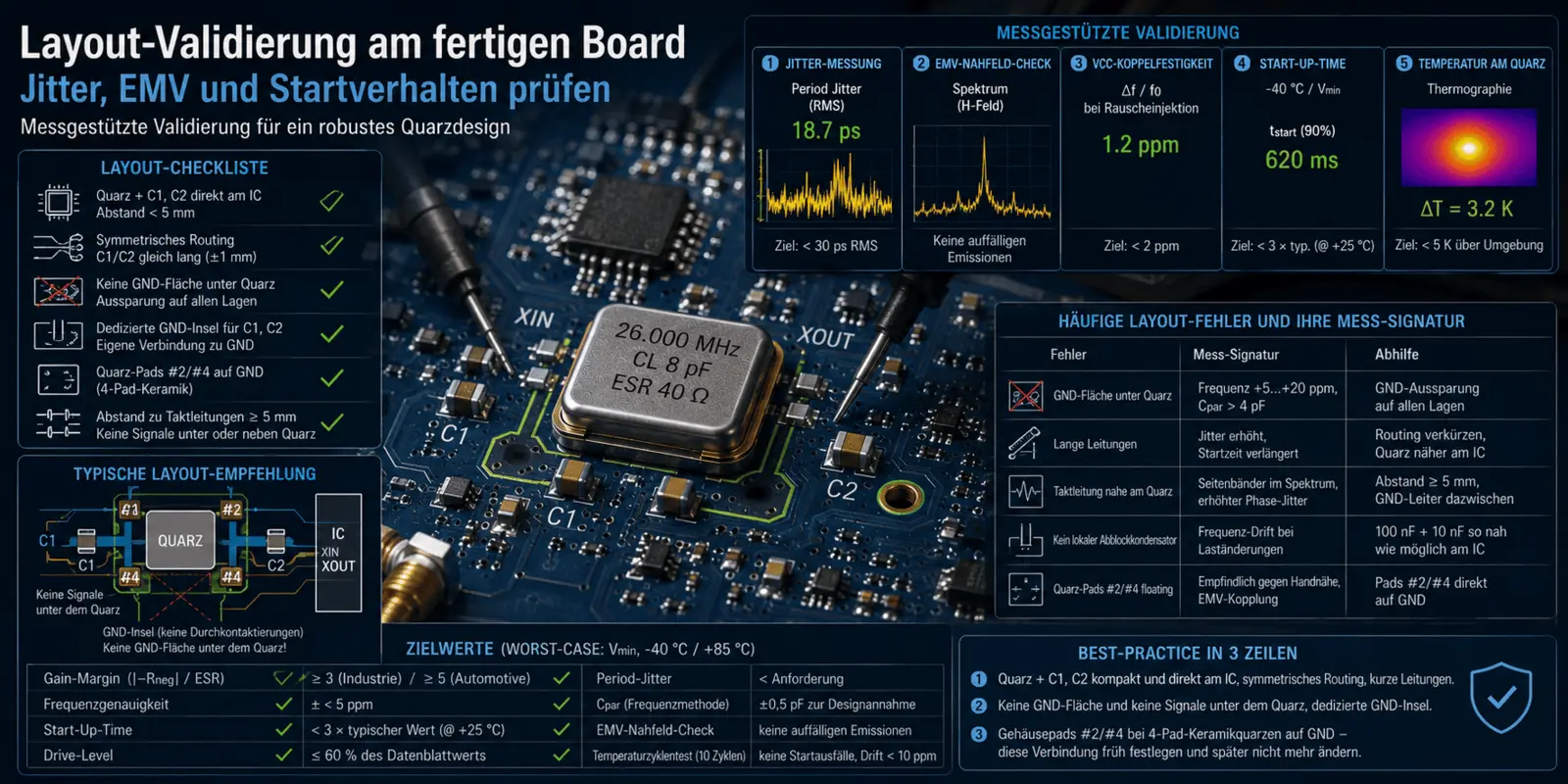
A poor PCB layout can make even an optimally selected crystal unusable. At the same time, the layout affects several properties simultaneously - parasitic capacitance, |-Rneg| reserve, jitter, EMC behaviour and transient response. This post describes a structured test that is used to finally validate a crystal layout on the finished board.
Layout checklist (design check)
Before the measurement, the layout is checked against the established design rules:
| Rule | Criterion | Test |
|---|---|---|
| Position | Quartz + C1, C2 directly at IC | Distance < 5 mm to XIN/XOUT |
| Symmetry | C1/C2 lines of equal length | ±1 mm difference |
| Isolation | No signals under or next to quartz | Wedge ring around quartz ≥ 2 mm |
| ground plane | No GND plane directly under quartz | recess on all layers |
| GND island | Dedicated GND area for C1, C2 | Dedicated connection to main GND |
| Quartz housing | Pads #2/#4 on GND (4-pad ceramic) | direct connection, < 1 mm |
| protection | No change of layers under quartz | Vias outside |
| EMV | Distance to clock lines | ≥ 5 mm to clock lines |
| Humidity/creepage paths | Conformal coating distance | Consider harsh environment |
Measurement-based layout validation
The following measurements on the finished board reveal the typical layout weaknesses:
Validation 1: Jitter measurement at the oscillator output
- Oscilloscope ≥ 1 GHz with jitter analysis function (period jitter, cycle-to-cycle jitter)
- Measurement point: output of the clock signal driven by the crystal oscillator (PLL output, SYSCLK pin, UART baud rate pin)
- Expectation: period jitter < 30 ps RMS for standard applications; < 10 ps RMS for USB, Ethernet, HDMI
Increased jitter (< 50 ps RMS) indicates coupling from neighbouring signals, improper grounding or too low a drive level.
Validation 2: EMC pre-test - near-field probe
- Near-field probe (H-field, 10 - 30 mm diameter) with spectrum analyser or Signalhound BB60C
- Scanning of the area via quartz, capacitors and IC
- Expectation: Fundamental frequency visible, clearly dominant. Harmonics attenuated.
Alarm signals: high harmonics (> 3rd order) or clear emissions at points away from the crystal indicate coupling and layout problems. (See also the case study https://www.petermann-technik.de/praxis-wissen/40mhz-quarz-emv-verbessern-fallbeispiel.html
Validation 3: VCC coupling strength
- Inject a noise injector or function generator into the VCC line (50 - 200 mVpp noise, bandwidth 10 kHz - 100 MHz)
- Observe frequency stability and jitter at the output
Expectation: Frequency changes by < 2 ppm, jitter remains within the specified range. Strong deflections indicate insufficient local VCC decoupling at the oscillator IC.
Validation 4: Cold start
- Climate chamber at -40 °C (or cold spray), VCC at Vmin
- At least 30 switch-on processes. Each must swing on safely (see post on start-up time)
Most common layout error that comes to light here: Cpar too high, causing |-Rneg| to fall below ESR in the worst case.
Validation 5: Temperature profile on the quartz housing
- Thermal imaging camera or thermocouple directly on the quartz housing
- Expectation: quartz housing < 5 K above ambient temperature
If the quartz heats up significantly (> 10 K), the drive level is too high - see post on drive level measurement. The consequences are accelerated ageing and drift.
Frequent layout errors and their measurement signature
| Layout errors | Typical measurement signature | Remedy |
|---|---|---|
| GND area under quartz | Frequency shift +5 to +20 ppm, Cpar > 4 pF | GND cut-out on all layers |
| Long leads (> 10 mm) | Jitter increased, start time extended | shorten routing, quartz closer to IC |
| C1/C2 placed asymmetrically | Different amplitudes at XIN/XOUT, drive level asymmetrical | Symmetrical routing |
| Clock line close to the quartz | Sidebands in the spectrum, increased phase jitter | Distance ≥ 5 mm, if necessary. GND conductor in between |
| No local blocking capacitor (100 nF) on IC VCC | Frequency drift with load changes | 100 nF + 10 nF as close as possible to the IC |
| Vias under quartz | Increased jitter, poor EMC | Via free space under quartz, adjust routing |
| Quartz housing pads floating | Sensitive to hand proximity, EMC coupling | Pads #2/#4 directly on GND |
Final design approval
We recommend a summarised test table before series approval. All points must be passed at the worst-case operating point (Vmin, -40 °C or +85 °C depending on the application, worst-case component tolerance):
| Test point | Target | Acceptance |
|---|---|---|
| Frequency accuracy at +25 °C, Vnom | ± < 5 ppm | Pass |
| Gain-Margin (|-Rneg| / ESR) Worst-Case | ≥ 3 (Industry) / ≥ 5 (Automotive) | Pass |
| Start-Up-Time Worst-Case | < 3× typical value at +25 °C | Pass |
| Drive level | ≤ 60% of the quartz data sheet value | Pass |
| Period jitter | < application request | Pass |
| Cpar from frequency method | within design assumption ±0.5 pF | Pass |
| EMV near-field check | no noticeable emissions except quartz useful frequency | Pass |
| Temperature cycle test 10 cycles -40/+85 °C | no start failures, no drift > 10 ppm | pass |
Layout best practice in three lines
The most important rules at a glance 1. Quartz + C1, C2 compact and directly on the IC, symmetrical routing, short lines. 2. No GND area and no signals under the crystal, dedicated GND island for the capacitors. 3. Housing pads #2/#4 on 4-pad ceramic crystals on GND - define this connection early on and do not change it later for frequency equalisation. |
Further information
The layout principles are described in the practical guide "Matching crystals optimally to ICs" (sections G and 6). This post supplements the guide with measurement-based validation on the finished board - from jitter check to worst-case acceptance.</p
<p>You have questions about implementation
Our frequency experts will support you in selecting the right crystal, taking measurements in your circuit and providing design-in support through to series release.
- Request technical advice
- Discuss your application with us
- Define and order a sample crystal
- Request an alternative via cross reference
Phone: +49 8191 305395 Email: info@petermann-technik.de
Your success is our goal.
FAQ – Questions and answers on layout validation of the finished board – checking jitter, EMC and start-up behaviour
Questions and brief, easy-to-understand answers on layout validation of the finished board – checking jitter, EMC and start-up behaviour
How is a quartz layout validated by measurement on the finished board?
The metrological validation of a crystal layout on the finished board is carried out in a structured manner using several tests that reveal typical layout weaknesses. These include, in particular, the jitter measurement at the oscillator output, a preliminary EMC test with a near-field probe, the VCC coupling strength test, the cold start test and the temperature measurement directly on the crystal housing. Prior to these measurements, the layout should already be checked against established design rules so that obvious faults can be detected early on. It is crucial that all tests are also carried out at the worst-case operating point, i.e. at minimum supply voltage, critical temperature and component tolerances. Only when the board has fully passed this validation is there a reliable basis for series release.
Which jitter limits apply to the layout validation of crystal and oscillator circuits?
In layout validation, jitter measurement is a key indicator of the quality of clock generation on the finished board. The site specifies a period jitter of less than 30 ps RMS as the expected value for standard applications, while less than 10 ps RMS is the target for demanding interfaces such as USB, Ethernet or HDMI. Increased jitter of over 50 ps RMS indicates layout problems such as coupling of neighboring signals, improper ground routing or a drive level that is too low. Measurements are taken at the output of the clock signal driven by the crystal oscillator, for example at the PLL output, SYSCLK pin or UART baud rate pin. For reliable results, an oscilloscope with a bandwidth of at least 1 GHz and a jitter analysis function for period jitter and cycle-to-cycle jitter should be used.
How do you recognize EMC problems in the crystal layout on the PCB?
EMC problems in the crystal layout can be detected very well on the finished board using a near-field probe and a spectrum analyzer. The area above the crystal, load capacitors and oscillator IC is systematically scanned in order to make the local radiation visible. It is expected that the fundamental frequency clearly dominates and higher harmonics are clearly attenuated. If high harmonics above the third order or clear emissions occur at points away from the crystal, this indicates undesirable coupling and layout errors. Such measurement signatures help to specifically identify problems in the conductor routing, ground connection or decoupling.
Why is it so important to test the VCC coupling strength for quartz layouts?
Testing the VCC coupling strength shows how robust the oscillator circuit is designed to withstand interference on the supply voltage. For this purpose, noise with typically 50 to 200 mVpp and a bandwidth of 10 kHz to 100 MHz is coupled into the VCC line, while frequency stability and jitter are observed at the output. Ideally, the frequency changes by less than 2 ppm and the jitter remains within the specified limits. Large deviations indicate insufficient local VCC decoupling at the oscillator IC. This validation is particularly important because supply couplings frequently occur in real system operation and can directly influence the clock quality.
What typical layout errors occur during a cold start and when measuring the temperature of the quartz crystal?
Typical weaknesses of a quartz layout become particularly apparent during the cold start test and temperature measurement. During the start test in the climatic chamber at -40 °C or with cold spray and at minimum supply voltage, the oscillator must oscillate reliably in at least 30 switch-on processes. If the oscillation does not occur or is unstable, the parasitic capacitance is often too high, so that the |-Rneg| reserve falls below the ESR value in the worst case. In addition, the temperature measurement on the quartz housing shows whether the drive level has been selected correctly. If the housing heats up by more than 5 K above ambient or even well above 10 K, the quartz is being driven too high, which can accelerate ageing and frequency drift.
Why PETERMANN-TECHNIK layout validation on the finished board - check jitter, EMC and start-up behavior?
PETERMANN-TECHNIK specializes in quartz crystals, oscillators and frequency-generating components and combines component know-how with practical measurement and layout expertise. The company not only provides support in selecting the right quartz crystal, but also with measurements directly in your circuit and with design-in support through to series release. This combination of theory and validation on the finished board is particularly valuable when it comes to issues such as jitter, EMC, VCC coupling strength and safe starting behavior. The structured approach helps to reliably identify critical layout errors before series production and to evaluate them in a technically sound manner. For industrial B2B applications, this means greater development reliability, lower risk in the field and a reliable release under worst-case conditions.


