
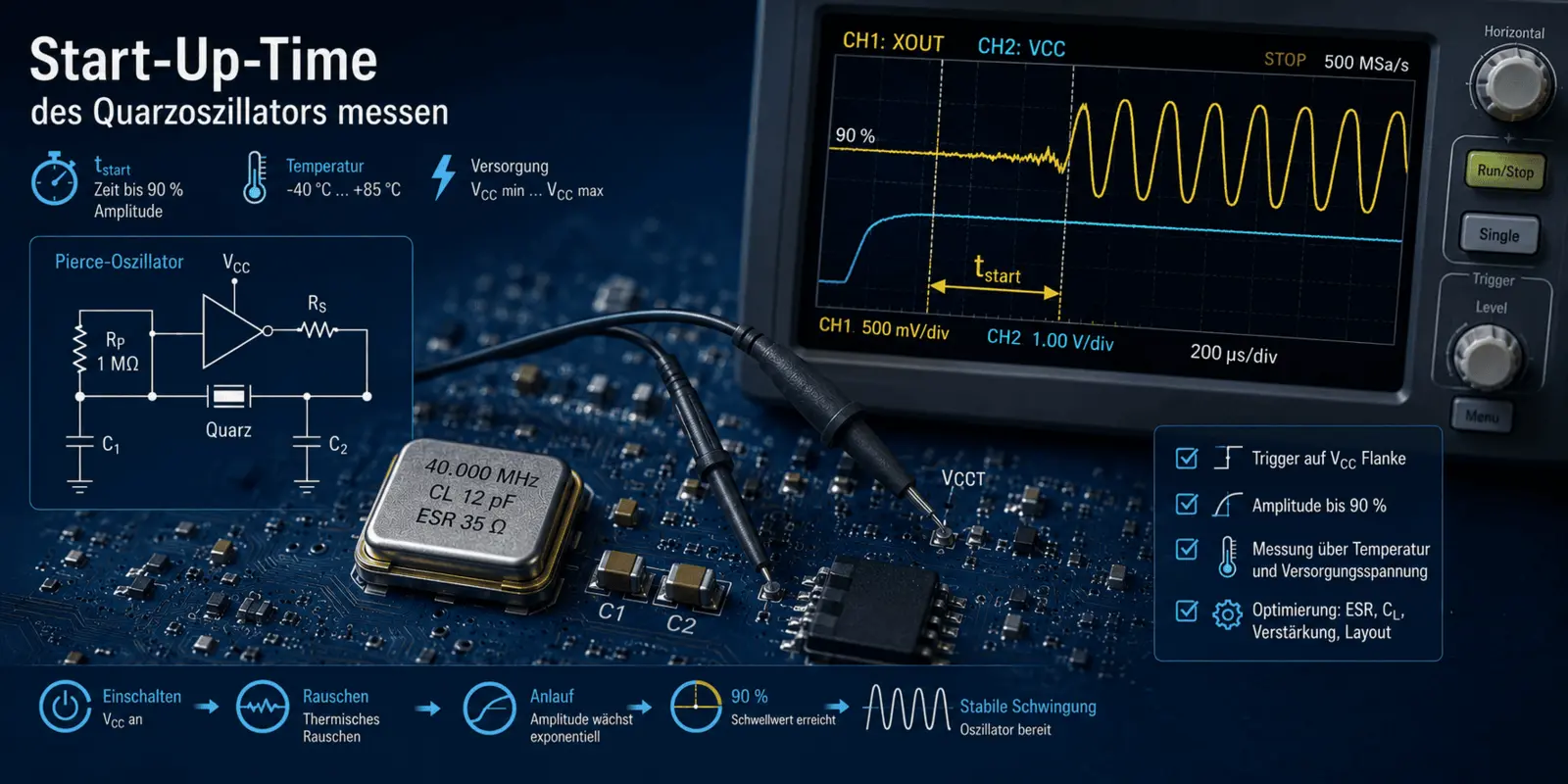
Practical measurement methods for the post "Optimising quartz crystals for ICs" - sections E and 4
To the encyclopaedia article : Matching crystals optimally to ICs
What it's all about:
The start-up time is the time between switching on the supply voltage (or enabling the oscillator in the MCU) and reaching a stable, usable oscillation. It is particularly critical for low-power MCUs with frequent sleep/wake cycles because each start process is directly included in the energy balance and determines the overall latency.
Typical requirements: < 2 ms for fast MCUs with a strong oscillator, 2 - 10 ms for standard designs, 250 - 1000 ms for 32.768 kHz clock crystals.
Influence variables
- Gain of the oscillator in the IC (|-Rneg|)
- ESR of the crystal
- Load capacitance CL or actually effective C1, C2 and Cpar
- Temperature (-40 °C significantly longer than +25 °C)
- Supply voltage (low VCC extends start time exponentially)
- Quality of the VCC ramp (rise time, monotony)
Definition of the start-up time
The start-up time is usually defined as the time at which the oscillation amplitude reaches 90% of its steady-state final value. Some MCU manufacturers define it differently as reaching the digital logic level or as enabling the XOSC ready flag.
| Definition | Measurement point | Typically used by |
|---|---|---|
| 90 % criterion | Oscilloscope to XOUT | Quartz manufacturer, laboratory practice |
| 95 % criterion | Oscilloscope to XOUT | Strict Automotive-Spec |
| Logic level at output | Clock output / GPIO | MCU data sheet |
| XOSC-Ready-Flag | Status register / GPIO toggle | MCU firmware view |
Measurement setup
Equipment
- Oscilloscope ≥ 500 MHz, ≥ 2 GS/s, deep memory depth (≥ 1 MPt)
- Active FET probe on XOUT (low input capacitance, ≤ 1 pF)
- Second channel on VCC (directly on the IC's supply pin)
- Optional: third channel on a GPIO that is toggled by the MCU startup code (e.g. for XOSC-Ready). e.g. for XOSC ready flag)
- Measurement tip with short ground reference (< 5 mm) to minimise ground inductance
Pass-through
- Triggering: edge on VCC (e.g. at 50 % of Vnom) or on the GPIO that marks the oscillator switch-on.
- Set time base to the expected start range - for MHz crystals typically 0.2 ms/div (total window 2 ms), for 32.768 kHz crystals typically 50 ms/div.
- Record at least 3 times the expected start time to capture the transient process completely.
- Evaluation: Determine the envelope of the XOUT oscillation. t_start is the time at which 90 % of the steady-state amplitude is reached.
- For series evaluation: Record 10 - 30 individual starts (persistence mode) and evaluate the longest start time as the worst case.
Important when triggering Do not trigger on the oscillation itself. The oscillator starts out of the noise, and triggering on any edge of the increasing amplitude systematically distorts the start time. Always trigger on the external event: VCC edge or GPIO pulse of the MCU startup code. |
Characterise start-up time via temperature and voltage
A single measurement at +25 °C and nominal voltage is insufficient. The following matrix is recommended for robust designs:
| Temperature | VCC | Measurement | Acceptance |
|---|---|---|---|
| +25 °C | Vnom | Reference | Base value |
| -40 °C | Vnom | Cold | < 3× base value |
| +85 °C | Vnom | Heat | < 1.5× base value |
| +25 °C | Vmin (-10 %) | Limit voltage | < 2× base value |
| -40 °C | Vmin | Worst-Case-Combination | < 5× base value |
| +25 °C | VCC ramp slow (5 ms) | monotonicity check | oscillation starts safely |
Interpretation of the envelope
The envelope of the starting oscillation normally follows an exponential function:
U(t) = U_rausch - exp( t / τ ) with τ = 2-L1 / (|-Rneg| - ESR)
Two anomalies provide valuable clues:
Plateau in the run-up (amplitude does not continue to grow, then suddenly does): Indicates borderline |-Rneg| reserve. Often at low temperatures or low VCC. Countermeasure: Quartz with lower ESR.
Overshoot of the amplitude (stationary value is briefly exceeded): Shows strong amplification, usually uncritical. However, may be accompanied by a brief increase in the drive level - check for ageing effects with very sensitive quartz crystals.
Typical measured values
| Quartz type | Oscillator | t_start (90 %) typ. |
|---|---|---|
| MHz standard SMD | Strong MCU-OSC | 0.3 - 1.5 ms |
| MHz Standard-SMD | Low-Power-MCU | 1 - 5 ms |
| MHz LRT quartz low ESR | low-power MCU | 0.5 - 2 ms |
| 32,768 kHz clock quartz | RTC oscillator | 250 - 800 ms |
| 32.768 kHz clock crystal, CL = 4 pF | Low-Power RTC | 500 - 1500 ms |
Improvement measures if the start time is too long
- Select crystal with significantly lower ESR (factor 2 - 3 compared to specification maximum)
- Reduce load capacitance if permitted by MCU (lower C1/C2 and thus CL_eff)
- Configure oscillator gain stage in MCU to "High Drive" / "Fast Start"
- Reduce layout parasitics (see post on parasitic capacitances)
- For clock crystals: In low-power applications, favour LRT technology to keep start time and start-up reserve safe even at low VCC
Further information
The correlations between start time, ESR, gain and temperature are described in the practical guide "Optimally matching crystals to ICs" (sections E and 4). This post provides the measurement practice for this - from the trigger strategy to temperature characterisation.
You have questions about implementation
Our frequency experts will support you in selecting the right quartz crystal, taking measurements in your circuit and providing design-in support through to series release.
- Request technical advice
- Discuss your application with us
- Define and order a sample crystal
- Request an alternative via cross reference
Phone: +49 8191 305395 Email: info@petermann-technik.de
Your success is our goal.
FAQs
How do you correctly measure the start-up time of a crystal oscillator?
The start-up time is the time from switching on the supply voltage or enabling the oscillator until a stable, usable oscillation is reached. In practice, it is usually defined as the time at which the oscillation amplitude reaches 90 % of its steady-state final value. For a clean measurement, an oscilloscope with at least 500 MHz and 2 GS/s, an active FET probe at XOUT and a second channel directly at the VCC of the IC are recommended. Triggering is typically performed on the VCC edge or on a GPIO signal that marks the switch-on of the oscillator. It is also important to record at least three times the expected start time so that the complete transient process is reliably recorded.
What are the typical start-up times of crystal oscillators in MCU applications?
The typical start-up time depends heavily on the frequency, quartz type and oscillator design in the IC. With fast MCUs with a strong oscillator, values of less than 2 ms can often be achieved, while standard designs are usually in the range of 2 to 10 ms. 32.768 kHz clock crystals require significantly longer, with typical start times of 250 to 1000 ms. This time is particularly critical for low-power MCUs with frequent sleep and wake cycles, because each restart directly affects the energy balance and system latency. The start-up time should therefore always be evaluated in the context of the real application and not just on the basis of a typical data sheet value.
Which factors have a particularly strong influence on the start-up time of a quartz oscillator?
The most important influencing variables include the gain of the oscillator in the IC, the ESR of the quartz and the effective load capacitance from C1, C2 and parasitic capacitances. The temperature also plays a major role, as the start-up time at -40 °C is often significantly longer than at +25 °C. In addition, a low supply voltage extends the start-up time exponentially, especially with a marginal starting reserve. The quality of the VCC ramp, i.e. its rise time and monotony when switching on, is also relevant. For robust designs, characterization should therefore always be carried out using temperature and voltage and not just at nominal conditions.
How do you interpret plateau and overshoot when a crystal oscillator starts up?
A plateau during start-up means that the amplitude initially stops increasing and only increases again later. This behavior typically indicates a borderline reserve of the negative resistor |-Rneg| and often occurs at low VCC or low temperatures. In such cases, a crystal with a lower ESR can help to improve the start-up reserve and shorten the start-up time. Amplitude overshoot, on the other hand, usually indicates a strong amplification of the oscillator and is not critical in many cases. Nevertheless, it should be checked whether an increased drive level occurs for a short time, which can promote long-term ageing effects in very sensitive quartz crystals.
How can an excessively long start-up time for quartz oscillators be improved?
An effective measure is to select a crystal with a significantly lower ESR, ideally by a factor of 2 to 3 below the specified maximum. In addition, the load capacitance can be reduced, provided this is permitted by the MCU oscillator and the actual effective CL is reduced as a result. Many microcontrollers also offer settings such as High Drive or Fast Start, which can be used to specifically increase the gain level of the oscillator. An optimized layout with lower parasitic capacitances also helps to improve the starting conditions. For clock crystals in low-power applications, the use of LRT technology can also be useful in order to keep the start time and start-up reserve stable even at low supply voltages.
Why does PETERMANN-TECHNIK measure the start-up time of the quartz oscillator?
PETERMANN-TECHNIK supports companies in the selection of suitable crystals and in the metrological evaluation directly in the real circuit. This allows start-up time, transient response and critical boundary conditions such as temperature, VCC and load capacitance to be assessed in a practical manner. The combination of component know-how and design-in support up to series release is particularly valuable. In this way, not only are measured values recorded, but specific improvement measures for robust and energy-efficient oscillator designs are also derived. PETERMANN-TECHNIK is therefore a competent partner for industrial B2B applications when it comes to reliable frequency solutions and robust measurement results.


