
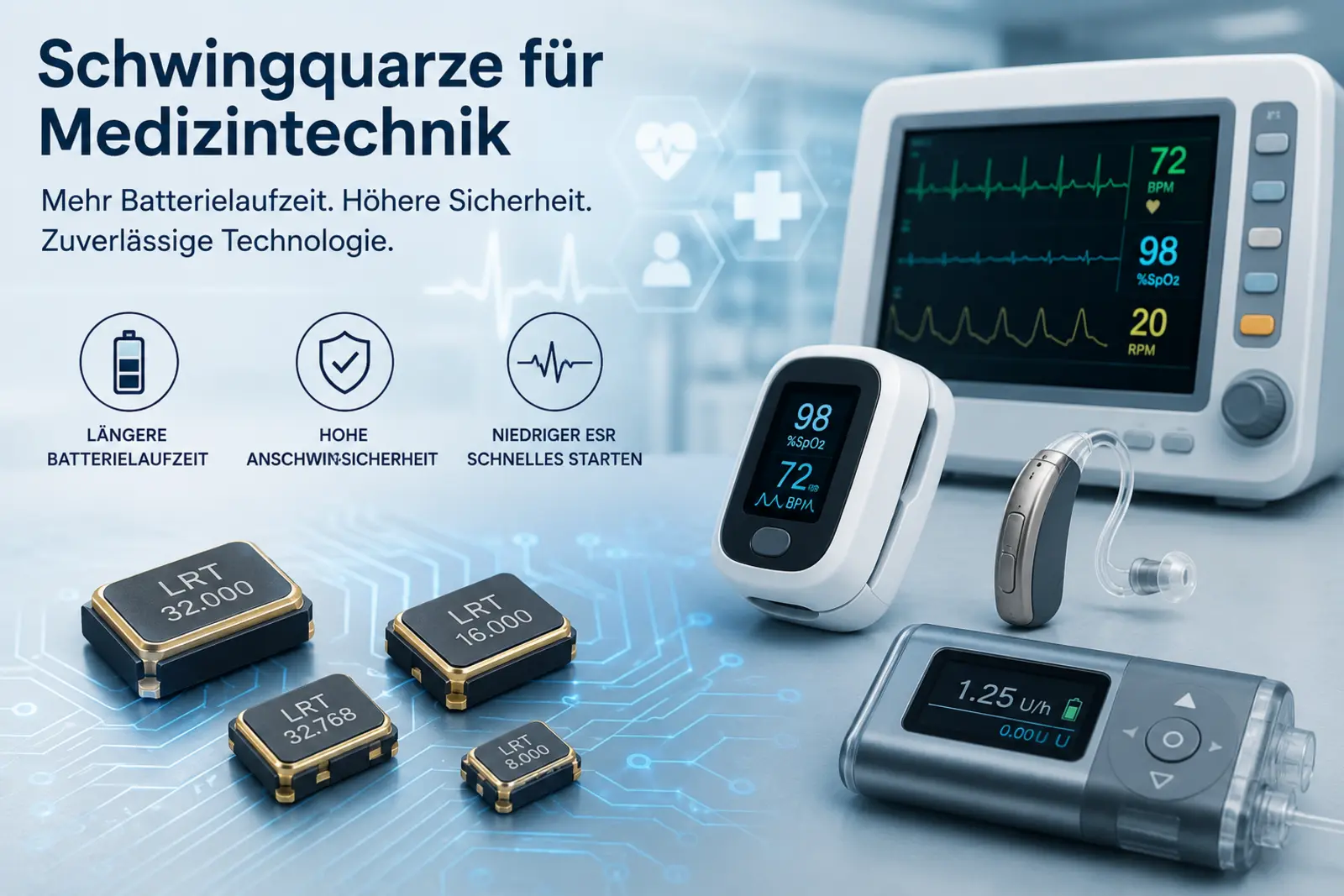
Energy efficiency starts with the clock
Battery-powered medical devices must operate reliably over long periods whilst consuming as little energy as possible. Whether portable patient monitors, insulin pumps, pulse oximeters, hearing aids or networked sensors – every microwatt saved extends the operating time and reduces maintenance requirements. In addition to microcontrollers and wireless technology, the crystal oscillator used also has a significant influence on a system’s energy requirements.
An important factor is the equivalent series resistance (ESR) of the quartz resonator. The lower this value, the faster the oscillator reaches its stable operating state. This shortens the settling phase, during which the circuit draws a higher current. Particularly in devices that regularly wake up from sleep mode, this effect adds up over many thousands of operating cycles to result in a noticeable energy saving.
Low ESR for fast and reliable oscillator start-up
With LRT (Low ESR Resonator Technology), PETERMANN-TECHNIK offers quartz resonators in which the series resistance has been specifically reduced. The result is resonators with particularly good response characteristics and high stability in practical use.
To ensure consistent product performance over many years, only quartz resonators developed and manufactured in-house are used. This ensures consistent product performance over many years. This long-term stability is of particular importance in medical technology, as products are often manufactured and approved without change for many years. In addition, every single LRT quartz crystal is fully tested, ensuring that only calibrated components are delivered.
Reliability as a key safety factor
In medical applications, an oscillator that starts up reliably is far more than just a convenience feature. Devices must operate reliably even under difficult conditions – for example, at low battery voltage, with significant temperature fluctuations or due to variations between individual electronic components.
Thanks to their reduced ESR, LRT crystal oscillators have a high oscillation margin. This increases the likelihood of a reliable start-up even in critical circuits where the oscillator amplifier offers only a small margin. This gives developers additional confidence when designing their hardware and enables them to significantly reduce the risk of problems arising during mass production.
Benefits for radio applications
Many modern medical devices now communicate wirelessly, for example via Bluetooth® Low Energy or other low-power wireless standards. In addition to reliable start-up, frequency stability therefore also plays an important role.
A precise clock source supports stable wireless connections and can help to prevent transmission retries. This shortens the system’s active transmission time, which further reduces energy consumption whilst simultaneously improving communication quality.
Suitable designs for compact devices
A wide range of SMD and THT crystal oscillators is available for modern medical electronics. Compact ceramic packages such as 3.2 × 2.5 mm, 2.0 × 1.6 mm or 1.6 × 1.2 mm are in particularly high demand, as they are ideally suited to space-critical designs.
PETERMANN-TECHNIK also offers resistance-optimised solutions for real-time applications at 32.768 kHz and for particularly small form factors. This enables developers to select both MHz and kHz clock sources from a single product family and optimise their systems in terms of power consumption and reliability.
Long-term availability and development support
In addition to its core frequency products, PETERMANN-TECHNIK supports developers right from the design stage of new devices. This includes, amongst other things, in-circuit measurements, analysis of the settling time, assessment of the drive level, and optimisation of the load capacity directly within the target circuit.
Another key focus is on the long-term availability of products. Particularly in the medical sector, with its long product life cycles and extensive approval procedures, a clock source that is consistently available makes a significant contribution to investment and planning security.
About PETERMANN-TECHNIK
PETERMANN-TECHNIK GmbH, based in Landsberg am Lech, has been developing and marketing high-quality frequency products for industrial and medical applications since 1996. The company supports its customers from the selection of suitable quartz crystals through the design-in phase right through to series production, placing particular emphasis on product quality, long-term availability and technical advice.
FAQ – Questions and answers about resistance-optimised quartz crystals
Questions and brief, easy-to-understand answers about resistance-optimised quartz crystals
What are resistance-optimised quartz crystals, and why are they important for energy-efficient medical technology?
Resistance-optimised quartz crystals are quartz resonators with a deliberately reduced series resistance, also known as ESR. A low ESR improves the oscillator’s settling behaviour and shortens the settling phase, during which the circuit typically requires more current. This is particularly relevant in battery-powered medical devices that regularly wake up from sleep mode. Over many operating cycles, this can result in noticeable energy savings. At the same time, operational reliability is improved, as the oscillator starts up more reliably even under demanding conditions.
How does a low ESR affect the battery life of medical devices?
A low ESR ensures that the oscillator reaches its stable operating state more quickly. This reduces the duration of the increased current draw during start-up. In portable patient monitors, insulin pumps, pulse oximeters, hearing aids or networked sensors, this can measurably extend battery life. The effect is particularly significant in applications with frequent wake-up cycles from power-saving mode. Every microwatt saved helps to reduce maintenance requirements and increase the device’s availability.
What advantages do LRT resonant crystals offer in medical devices under difficult start-up conditions?
LRT crystal oscillators from PETERMANN-TECHNIK have been designed to reduce their series resistance, thereby increasing the oscillation margin. This improves the likelihood of a reliable start-up, even when the battery voltage is low or temperature fluctuations occur. Circuits whose oscillator amplifiers offer only a small margin also benefit from this. For developers, this means greater certainty in hardware design and a lower risk of subsequent production problems. In medical technology in particular, an oscillator that starts reliably makes an important contribution to functional safety.
Why is the frequency stability of quartz crystals crucial for wireless medical technology?
Many modern medical devices use energy-efficient wireless standards such as Bluetooth Low Energy and therefore rely on a precise clock source. High frequency stability ensures stable wireless connections and improves communication quality in practical use. Avoiding retransmissions shortens the system’s active transmission time. This further reduces energy consumption and helps extend battery life. For networked medical sensors and wearable devices, this is a key advantage in day-to-day operation.
What package types and frequency ranges are available for resistance-optimised quartz crystals in medical technology?
Resistance-optimised quartz crystals are available in a wide range of SMD and THT versions for modern medical electronics. Compact ceramic packages in sizes such as 3.2 × 2.5 mm, 2.0 × 1.6 mm or 1.6 × 1.2 mm are particularly in demand for space-critical designs. PETERMANN-TECHNIK also offers solutions for real-time applications at 32.768 kHz as well as for MHz clock sources. This enables developers to meet both kHz and MHz requirements within a single product family. This simplifies the optimisation of power consumption, form factor and reliability in medical devices.
Why is PETERMANN-TECHNIK the best choice for resistance-optimised quartz crystals in medical technology?
PETERMANN-TECHNIK develops and manufactures its own quartz resonators, thereby ensuring consistent product performance over many years. This is particularly important in medical technology, as products are often manufactured and approved to remain unchanged over the long term. Every single LRT quartz crystal is fully tested, ensuring that only calibrated components are delivered. In addition, the company supports developers with in-circuit measurements, analysis of the margin of oscillation, assessment of the drive level and optimisation of the load capacity directly within the target circuit. Combined with long-term supply reliability and technical consultancy, this makes PETERMANN-TECHNIK a strong choice for demanding medical applications.


