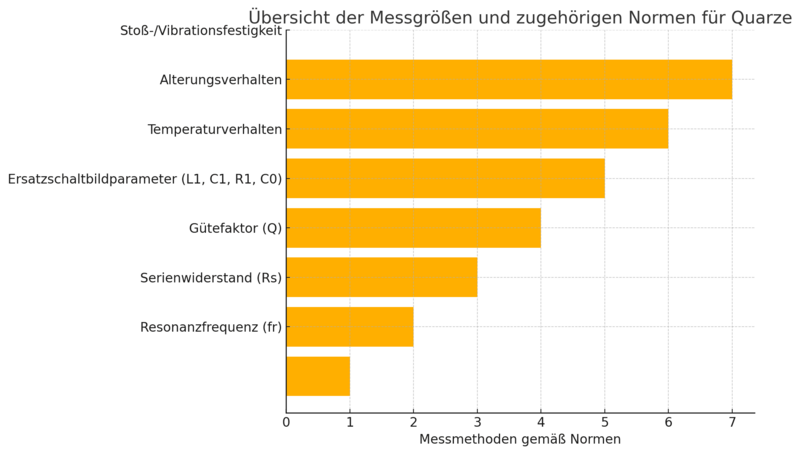

There are several relevant standards for the measurement of quartz crystals (i.e. oscillating crystals or quartz oscillators), mainly from the IEC (International Electrotechnical Commission), DIN, MIL and, where applicable, JEDEC and IEEE. These standards regulate the measurement methods, test conditions, limit values and environmental tests for quartz crystals. Here is an overview:
1. IEC standards (International Electrotechnical Commission)
IEC 60444 series: Measurement methods for piezoelectric quartz resonators
This series of standards is central to the measurement of quartz crystals:
- IEC 60444-1: Basic method for the measurement of resonance frequency and resonance resistance of quartz crystal units by zero-phase technique in a π-network
Describes the basic measurement method for:- Resonance frequency fr
- Series resistance Rs
(zero-phase method in π-network)
- IEC 60444-2: Guidelines for crystal units using the π-network
Supplement to Part 1: Application notes, adaptation of measurement conditions - IEC 60444-3: Method for the measurement of equivalent series resistance (ESR), Q, and motional parameters
Description of the measurement of:- Equivalent series resistance (ESR)
- Quality factor Q
- Resonant circuit parameters (L, C)
- IEC 60444-5: Method for the determination of equivalent circuit parameters of quartz crystal units using network analyser techniques
Network analyser method for determining the electrical equivalent circuit:- Series resonance fs, parallel resonance fp
- C0, C1, L1, R1
2. MIL standards (Military Standards, USA)
MIL-PRF-3098: Performance specification: Crystal units, quartz
Defines requirements and test methods for:
- Frequency stability
- Ageing behaviour
- Temperature behaviour
- Shock and vibration resistance
MIL-STD-202: Test methods for electronic and electrical component parts
Contains general environmental tests such as
- Temperature cycles
- Humidity exposure
- Shock and vibration
3 JEDEC standards (Joint Electron Device Engineering Council)
- JESD22 series: Test Methods for Electronic Components
Also applies to quartz crystals, e.g. for:- Thermal cycling (JESD22-A104)
- Humidity test (JESD22-A101)
- Lifetime tests (JESD22-A108)
4. DIN standards (German standards)
DIN EN 60444 corresponds directly to the international IEC 60444 series. DIN standards often use the suffix "EN" for IEC standards adopted in Europe:
- DIN EN 60444-1 to -5 → identical to IEC 60444-1 to -5