
Buy SMD oscillating crystals at low prices for automotive
These crystals are really cheap to buy for automotive applications, have a long service life, are available over the long term, can be delivered strategically and always oscillate very quickly and very reliably?
Due to their own interests, many market competitors recommend that users of automotive crystals use MHz oscillating crystals in 2.0x1.6mm/4pad or 32.768 kHz crystals in 1.6x1.2mm/2pad ceramic housings. From our point of view, there are much better and cheaper solutions.
Buy SMD oscillating crystals at low prices for automotive
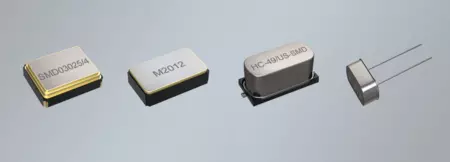
These crystal types are available at low cost for automotive applications, have a long service life, are available over the long term, can be delivered strategically and always oscillate very quickly and very reliably.
Due to their own interests, many market competitors recommend that users of automotive crystals use MHz oscillating crystals in 2.0x1.6mm/4pad or 32.768 kHz crystals in 1.6x1.2mm/2pad ceramic housings. From our point of view, there are much better and cheaper solutions.
MHz crystals in 3.2x2.5mm/4pad ceramic housing
We are the only supplier in the world that can cover the frequency range from 8 - 285 MHz in the AT base tone in the 3.2x2.5mm/4pad ceramic housing. This allows the circuit designer to cover an extremely wide frequency spectrum in the same package, which saves design-in and qualification costs.
In addition, the automotive crystals in the 3.2x2.5mm/4pad SMD ceramic housing are also based on our exclusive LRT technology (Low ESR Resonator Technology). Due to the very low resistance of the LRT resonators, a significantly faster and very safe transient response of the LRT quartz crystal is made possible, so that the current consumption of the circuit is reduced and a lower power requirement results. This enables the developer to achieve a transient response safety factor (SF) of greater than or equal to 10 under all circumstances. Even with low frequencies. Our SMD automotive crystals are available in the temperature range of -40/+125°C. The frequency tolerance at +25°C is ±10ppm. In addition to the quartz resonators manufactured in-house, the strategically secure supply of these 3225 SMD quartz crystals is based on another key advantage. This is because we have our own ceramic housing for this quartz resonator series and are therefore independent of Japanese fine ceramic manufacturers in particular.
MHz crystals in 3.2x2.5mm/4pad ceramic housing for shock and vibration
Quartz resonators are attached to the ceramic housing via various fixing points. Even the standard versions of our quartz resonators have twice as many fixing points as our mainly Japanese competitors in the automotive sector. We are the only supplier worldwide to offer an SMD quartz crystal in a 3.2x2.5mm/4pad ceramic housing that is ultrasonic welding resistant and can be used in applications that are ultrasonically welded. This is the SMD03025/4US series. Due to its design, this crystal is even more resistant to shock and vibration than the 3.2x2.5mm/4pad crystals of the SMD03025/4 series.
32.768 kHz SMD oscillating crystal in 3.2x1.5mm/2pad ceramic housing
During the corona pandemic, we were also able to deliver 32,768 kHz crystals in a 3.2x1.5mm/2pad ceramic case within 6 - 8 weeks. The background is quite simple. Because we have our own case, we are independent of the Japanese fine ceramic manufacturers and can strategically supply this 32,768 kHz quartz series at short notice under all circumstances. During the MLLC allocation in 2018, the relevant users were asked to use small MLCC housings. This was intended to increase production volumes at the relevant MLCC manufacturers and improve delivery performance. Many of our market competitors are now taking the same approach and recommending that their customers use 1.6x1.0mm/2pad 32.768 kHz watch crystals instead of the much cheaper standard version in a 3.2x1.5mm/2pad ceramic housing. This recommendation is due to the fact that all these suppliers use the same Japanese ceramic case manufacturers for the corresponding cases and, in the event of supply difficulties of whatever nature, will no longer be able to supply these small 1610 SMD crystals that they have suggested themselves. In this case, not only supplier X, but also all other suppliers of these small watch crystals will not be able to do so, because they usually buy from the same ceramic case manufacturer - with the main production line in Malaysia. A disaster for the respective user companies. In addition, the much higher ESR of the 1.6x1.0mm/2pad quartz crystals must also be taken into account. This is because a 1610 crystal has a standard ESR of 90 kOhm at -40/+85°C. This can result in major transient response problems with many 32.768 kHz oscillator stages, as the minimum transient response safety factors (SF) of greater than or equal to 10 can no longer be achieved and the 1610 quartz crystals therefore only transient very poorly or not reliably at all.
This is not the case with our 3215 32.768 kHz crystals. These have an ESR of 50 kOhm max. as standard and can optionally be supplied with a frequency tolerance of ±10ppm at +25°C (standard is ±20ppm at +25°C) in the temperature range of -40/+125°C. Thanks to our own housing, we are completely independent of any fine ceramic manufacturers and their interests. This means that we can supply SMD watch crystals in 3.2x1.5mm/2pad ceramic housings very reliably under all circumstances. Today, as well as tomorrow. Once designed in, always available.
FAQs
Which SMD oscillating crystals are particularly favorable for automotive applications and at the same time strategically available?
For automotive applications, SMD oscillating crystals in a 3.2x2.5mm/4pad ceramic housing offer a particularly economical and robust solution. PETERMANN-TECHNIK is the only supplier worldwide that can cover the frequency range from 8 to 285 MHz in the AT base tone in this housing. This reduces design-in and qualification costs because a very broad frequency spectrum can be realized with just one housing format. Added to this is the strategically secure supply capability, as a proprietary ceramic housing is used and there is therefore no dependence on Japanese fine ceramic manufacturers. This combination of price advantage, availability and technical reliability is particularly relevant for automotive projects with long running times.
Why are 3.2x2.5mm automotive crystals often the better choice than smaller 2.0x1.6mm or 1.6x1.0mm designs?
Smaller designs are often recommended on the market, but are not automatically the best technical or economic solution for automotive applications. At PETERMANN-TECHNIK, the 3.2x2.5mm/4pad ceramic housing covers an exceptionally wide frequency range from 8 to 285 MHz in the AT fundamental, thus simplifying development. In 32.768 kHz applications, very small 1.6x1.0mm/2pad crystals also have a significantly higher ESR, which can make oscillation more difficult. The larger standard 3.2x1.5mm/2pad package is often cheaper here and offers better conditions for reliable starting behavior. For developers, this means greater design reliability, lower risk and better long-term availability.
What are the advantages of LRT technology for SMD automotive crystals?
The exclusive LRT technology from PETERMANN-TECHNIK stands for Low ESR Resonator Technology and ensures a particularly low resistance of the resonator. As a result, the crystals oscillate significantly faster and more reliably, which is a significant advantage in automotive circuits. Safe transient response can help to reduce the current consumption of the circuit and lower the power requirement. According to page content, these crystals allow the designer to achieve a transient response safety factor of greater than or equal to 10 under all circumstances, even at low frequencies. For demanding automotive designs, this improves both functional reliability and energy efficiency.
For which temperature ranges and tolerances are the automotive SMD crystals available?
The SMD automotive crystals described are available for an extended temperature range of -40 to +125°C and are therefore designed for typical automotive requirements. This temperature resistance is important because electronic assemblies in vehicles are exposed to strong environmental influences. In addition, the frequency tolerance at +25°C is ±10 ppm, which supports precise frequency stability. This makes the crystals suitable for applications where both reliability and accuracy are required. In conjunction with the safe transient response, this results in a resilient solution for long-lasting automotive electronics.
What advantages do 32.768 kHz SMD crystals in a 3.2x1.5mm package offer for automotive applications?
32,768 kHz SMD crystals in 3.2x1.5mm/2pad ceramic housings offer clear advantages over smaller 1.6x1.0mm variants in terms of cost, availability and transient response reliability. PETERMANN-TECHNIK was able to deliver this series within 6 to 8 weeks even during the corona pandemic because it uses its own housing and is not dependent on Japanese ceramic housing manufacturers. Another important point is the lower ESR, as the standard 3215 version is significantly cheaper than very small 1610 crystals. High ESR values for small clock crystals can lead to considerable oscillation problems in many 32.768 kHz oscillator stages. The 3.2x1.5mm housing is therefore often the more robust and strategically safer choice for automotive projects.
Why buy PETERMANN-TECHNIK SMD oscillating crystals at low prices for automotive?
PETERMANN-TECHNIK is a particularly strong choice for automotive SMD oscillating crystals because it combines technical performance, price advantage and delivery reliability. The company is the only supplier in the world to offer a frequency range from 8 to 285 MHz in the AT base tone in a 3.2x2.5mm/4pad ceramic housing. Thanks to the exclusive LRT technology, developers benefit from low ESR, fast transient response and high operational reliability. Added to this is the strategically secure supply of our own ceramic housings, which creates important independence from external housing manufacturers. For industrial and automotive B2B customers, this means an economical, durable and reliable long-term solution.


