

FAQs
What is a quartz oscillator and how does it work?
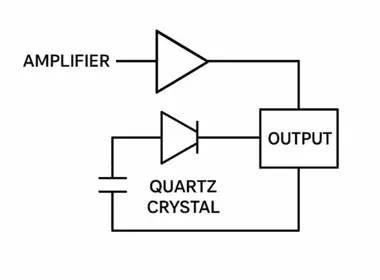
A quartz oscillator is an electronic circuit for generating a very precise clock frequency. Its function is based on a quartz oscillator, which is excited to stable mechanical oscillations by the piezoelectric effect. These oscillations are converted into an electrical signal with a defined frequency. Quartz oscillators are used wherever a reliable time or frequency base is required. Typical applications include communication systems, industrial electronics, measuring devices and digital control systems.
Why are crystal oscillators so important for precise frequency stability?
For decades, quartz oscillators have been regarded as key components for stable and precise frequencies. They keep electronic systems in sync and ensure that signals can be processed reproducibly and reliably. Especially in demanding applications, a constant frequency is crucial for function, synchronization and data integrity. Compared to less precise clock sources, quartz oscillators offer significantly greater stability. This is why they are indispensable in modern electronics and frequency technology.
Which applications use quartz oscillators in electronics and frequency technology?
Quartz oscillators are used in numerous electronic applications where precise clocking is required. These include communication devices, industrial control systems, embedded systems and measurement and testing technology. They are also an essential basis for stable operation in digital circuits and IC-based designs. Their task is to provide a defined reference frequency that the entire system can rely on. As a result, they make a significant contribution to the performance and operational reliability of electronic assemblies.
How can crystals be optimally matched to ICs?
In order for a quartz crystal in the oscillator stage of an IC to work stably and precisely, it must be carefully matched to the respective circuit. The electrical boundary conditions of the IC as well as the requirements for frequency, stability and starting behavior are decisive here. Inappropriate tuning can result in the oscillator not oscillating optimally or not achieving the desired accuracy. Therefore, selecting the right crystal for the respective IC design is an important development step. Proper tuning improves performance and increases the reliability of the entire application.
What should you look out for when choosing a crystal oscillator?
When selecting a crystal oscillator, the requirements of the specific application should be carefully considered. Important criteria are the required frequency, the desired stability and the integration into the respective electronic circuit. It also plays a role whether the oscillator must work optimally with certain ICs or system architectures. For industrial applications, high reliability over long operating times is also crucial. An application-specific selection ensures that the overall system is precise, robust and permanently stable.
Why PETERMANN-TECHNIK optimally tune crystal oscillators and crystals to ICs?
PETERMANN-TECHNIK specializes in frequency-generating components and has in-depth expertise in quartz crystals and crystal oscillators. The company supports customers in finding suitable solutions for precise and stable clock sources in industrial applications. Technical understanding is particularly important when matching quartz crystals to ICs in order to achieve reliable results. PETERMANN-TECHNIK combines application-oriented consulting with many years of experience in frequency technology. This provides B2B customers with expert support for efficient and reliable electronic designs.


